
I have spent the weekend at a symposium dealing with the role of religious experience in interreligious dialogue, organised by the Scottish Catholic Bishops Committee on Interreligious Dialogue. It’s not a topic that’s often discussed in interfaith circles but it’s an important and interesting one. The first question of course is what is a religious experience and Professor Will Storrar who facilitated the event settled on a sociological understanding of what he called ‘ordinary’ religious experiences to distinguish them from the overpowering peak experiences that some people undoubtedly have and that often lead to a conversion, whether that be of faith or way of life. The understanding of ordinary religious experience that Professor Storrer offered was that of a human experience that is interpreted within a particular religious framework. This suggests then that the experience itself is not religious but rather it is the story or interpretation that is given to it that labels it as such. It is well documented by projects such as the Alister Hardy Research Centre on Religious Experience that many people have experiences of the numinous, something that points beyond the mundane even though they are not religious and today many people are happy to claim they are spiritual but not religious, recognising a transcendent dimension of some sort to life but not subjecting themselves to religious authority or belief. I often hear older people lament the fact that the younger members of their family who have given up religion are deprived in some way or other by the absence of religion in their lives which can suggest that we believers think of ourselves as a bit superior. I want to disagree with this because deep down I believe that the experience of the transcendent is available to everyone and in that sense ‘unbelievers’ are not deprived of what is surely a human reality but might in fact be reacting against the very interpretation given to the experience by religion. What would be an example of this?
I would imagine that the birth of a baby would be one such instance. I don’t have children of my own but from my neices and nephews and great neices and nephews I have been in awe and wonder at the new life that has come in to our family. So I can imagine that this would be an overpowering experience for parents and particularly for mothers. A wonderful experience but is it necessarily a religious one? According to our definition it is the interpretation of this experience that makes it religious. It can be interpreted as a gift from God leading to a great sense of gratitude; the baby seen as reflecting the face of God and welcomed with an intense love. So far so good but what if the story and interpretation suggests that this beautiful creature is the bearer of an original sin that alienates it from God and can only be reconciled with God through baptism. This is the traditional christian story which more and more people are finding hard to accept and which has led some to reject the interpretation and even religion itself because it doesn’t adequately explain the reality of the experience. Connected to this too was the ritual of ‘churching’, when a new mother would go to Church for a blessing and ceremony of purification before returning to active membership of the community. This is obviously a throwback to a time when women were thought to be unclean during mentruation and child birth but I know women who have rejected catholicism because this experience was so alien to their human experience. They chose to give up their religion rather than their humanity.
Religious experience is an important part of interreligious dialogue and one to be encouraged. So often interfaith events are reflections from the point of view of each religion on a topic of common interest – side by side events rather than the face to face conversations that allow for insight into the religious experience of the other which then awakens a religious experience in oneself. John Dunne, a Catholic theologian, has said that the spiritual adventure of our day is to pass over into the world of other faiths and return to our own to see it with new eyes. For me this has been true. I have been privileged to study world religions and to teach them, hopefully with respect and an understanding of what they might mean to believers. I have read and introduced students to the scriptures of other faiths and been touched by both their beauty and wisdom. I have been to festivals and services in places of worship which has given me an insight into what worship means even if it was not a religious experience for me. On two occasions I was privileged to travel in India with two Hindu friends, husband and wife. For them this was a religious pilgrimage, sensing the holiness of what was for them a holy land. One instance stands out for me. It was when we went to Allahabad where the three sacred rivers, the Ganga, Yamuna and Saraswati meet. It is a custom to go to the meeting point by boat, bathe and make prayer and offerings to God. I’m afraid I didn’t bathe but my friend did and was moved by what was for her a cleansing and liberating ritual. I felt I could understand these sentiments and was affected by her devotion and response.
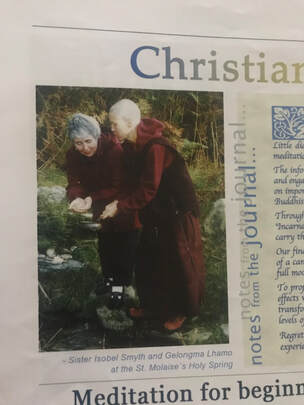
Another significant moment of a religious experience within the context of dialogue was with my Tibetan Buddhist friend Ani Lhamo. We were leading a week on the island of Iona at the invitation of the Iona Community. The weather was glorious and the island sparkling in its beauty. Ani Lhamo and I planned our sessions together but each day had plenty of time to talk and share our experience of faith and of religious life. We sometimes tried to find readings that would take the participants in the course from the head to the heart. My memory is that I suggested Francis Thompson’s poem the Hound of Heaven, which talks of God’s search for us and finding us even if we try to run away from it. Ani Lhamo was very touched by this and it occurred to me that she and I felt the same attraction to spirituality and prayer which demanded a life-time commitment. Tibetan Buddhists do not believe in a Creator God and would not use God language to describe this attraction as I would have done. But the reality of the attraction was surely the same and the Reality which is the source of all life and in which we all live and have our very being, whether it be called God or a universal Buddha nature was surely the same – just described differently.
I would imagine that the birth of a baby would be one such instance. I don’t have children of my own but from my neices and nephews and great neices and nephews I have been in awe and wonder at the new life that has come in to our family. So I can imagine that this would be an overpowering experience for parents and particularly for mothers. A wonderful experience but is it necessarily a religious one? According to our definition it is the interpretation of this experience that makes it religious. It can be interpreted as a gift from God leading to a great sense of gratitude; the baby seen as reflecting the face of God and welcomed with an intense love. So far so good but what if the story and interpretation suggests that this beautiful creature is the bearer of an original sin that alienates it from God and can only be reconciled with God through baptism. This is the traditional christian story which more and more people are finding hard to accept and which has led some to reject the interpretation and even religion itself because it doesn’t adequately explain the reality of the experience. Connected to this too was the ritual of ‘churching’, when a new mother would go to Church for a blessing and ceremony of purification before returning to active membership of the community. This is obviously a throwback to a time when women were thought to be unclean during mentruation and child birth but I know women who have rejected catholicism because this experience was so alien to their human experience. They chose to give up their religion rather than their humanity.
Religious experience is an important part of interreligious dialogue and one to be encouraged. So often interfaith events are reflections from the point of view of each religion on a topic of common interest – side by side events rather than the face to face conversations that allow for insight into the religious experience of the other which then awakens a religious experience in oneself. John Dunne, a Catholic theologian, has said that the spiritual adventure of our day is to pass over into the world of other faiths and return to our own to see it with new eyes. For me this has been true. I have been privileged to study world religions and to teach them, hopefully with respect and an understanding of what they might mean to believers. I have read and introduced students to the scriptures of other faiths and been touched by both their beauty and wisdom. I have been to festivals and services in places of worship which has given me an insight into what worship means even if it was not a religious experience for me. On two occasions I was privileged to travel in India with two Hindu friends, husband and wife. For them this was a religious pilgrimage, sensing the holiness of what was for them a holy land. One instance stands out for me. It was when we went to Allahabad where the three sacred rivers, the Ganga, Yamuna and Saraswati meet. It is a custom to go to the meeting point by boat, bathe and make prayer and offerings to God. I’m afraid I didn’t bathe but my friend did and was moved by what was for her a cleansing and liberating ritual. I felt I could understand these sentiments and was affected by her devotion and response.
Another significant moment of a religious experience within the context of dialogue was with my Tibetan Buddhist friend Ani Lhamo. We were leading a week on the island of Iona at the invitation of the Iona Community. The weather was glorious and the island sparkling in its beauty. Ani Lhamo and I planned our sessions together but each day had plenty of time to talk and share our experience of faith and of religious life. We sometimes tried to find readings that would take the participants in the course from the head to the heart. My memory is that I suggested Francis Thompson’s poem the Hound of Heaven, which talks of God’s search for us and finding us even if we try to run away from it. Ani Lhamo was very touched by this and it occurred to me that she and I felt the same attraction to spirituality and prayer which demanded a life-time commitment. Tibetan Buddhists do not believe in a Creator God and would not use God language to describe this attraction as I would have done. But the reality of the attraction was surely the same and the Reality which is the source of all life and in which we all live and have our very being, whether it be called God or a universal Buddha nature was surely the same – just described differently.

 RSS Feed
