
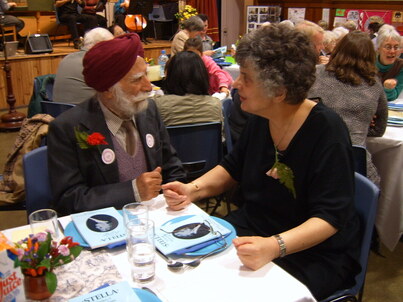
One of the principles of interreligious dialogue and interfaith relations is to understand the other as they would understand themselves. This is not always easy because of the differences in the understandings of faith within the community of believers in any religion. Should I understand the text book account of a faith, or the personal slant put on it by a believer, even if that is not accurate and even wrong according to the tradition? Should I be careful when talking of another faith to make clear this distinction and to share my own experience of that faith which may have come through reading, visiting places of worship or encountering the other in dialogue.
In my interfaith journey I have often encountered others whose knowledge of Christianity is not the same as mine and have sometimes been embarrassed at what I have heard said about Christianity or taken aback by lack of basic knowledge of the faith. On one occasion a Jewish friend suggested that because Christians believe in the Trinity they do not believe in the oneness of God. I have heard on more than one occasion a Buddhist comment on the christian understanding of the human person as sinful, alienated from God until he or she encounters Jesus who had to die a terrible death in order to be saved, something the Buddhist considered to be quite negative and not at all helpful compared to Buddhism. My Buddhist friend had got this fundamental, evangelical understanding of Christianity from being part of a group of believers from different faiths who had attended a school assembly to give an account of their faith. This is what the christian participant genuinely believed but it is not how I would express my faith and I would want people to know and appreciate that there are other ways of understanding and expressing it. I once took part in a Baha’i programme that often quoted Baha'u’llah’s understanding of christian concepts which I did not recognise as true. Baha'u’llah would have got these from somewhere and even if some of them were valid expressions in the 19th century they were not in the 21st century. Of course the point in exploring these was to show that a Baha’i understanding was better or more complete.
The reason this principle has been on my mind is because of what I read in Rabbi Jonathan Sacks reflection on last Shabbat’s parsha reading of the Torah. The parsha was from the beginning of Exodus and carried on from the previous parsha of how Moses failed in his attempt to free the the people of Israel from oppression and slavery in the land of Egypt. In this parsha God assured Moses that he would indeed lead the people to freedom and told him to announce it to them. Rabbi Sacks focuses on the verse that says “So Moses told this to the Israelites but they did not listen to him, to because their spirit was broken and because the labour was harsh”.(Ex. 69) Rabbi Sacks then expounds on this to show that “if you want to improve people's spiritual situation first improve their physical situation”. This he suggests is one of the most humanising aspects of Judaism which is a religion of protest against injustice, poverty, abuse etc.
This is good but he then suggests that Judaism is better at this than other faiths. He quotes Michael Novak, a catholic theologian,
“Jewish thought has always felt comfortable with a certain well ordered worldliness whereas the Christian has always felt a pull to other worldliness Jewish thought has had a candid orientation towards private property whereas Catholic thought -articulated from and early period chiefly among priests and monks - has persistently tried to direct the attention of its adherents beyond the activities and interests of this world to the next. As a result, tutored by the law and the prophets, ordinary Jews have long felt more at home in this world while ordinary Catholics have regarded this world as a valley of temptation and as a distraction from their proper business which is preparation for the world to come”.
This jarred with me as it it is not how I would understand my Catholicism. Yes I was brought up to believe the catechism answer that it was better to care more for my soul than body because “what doth it profit a man if he gains the whole world and suffers the loss of his own soul” but also to believe that love and care for others was at the heart of Christianity. In western culture education, health, social justice were practised by the same nuns and monks who withdrew into monasteries but only to serve the world. There is a whole tradition of social justice teaching within the Catholic Church from the end of the 19th cy, now called integral human development. There is a theology of the kingdom of God that asks Christians to work for justice, peace, equality, inclusion in this world and a theology of incarnation which does not separate the spiritual and the material. So Jews reading this reflection I suggest would end up with a wrong idea of Catholicism. Did Michael Novak really believe this? It so happens that Rabbi Sacks indicates that the theologian was actually citing someone called Irving Kristol, a Jewish journalist but doesn’t say why. So is this quotation more a limited Jewish understanding than a contemporary catholic one? I would suspect so.
How do we get over this? Only be study, experience and dialogue. So what perhaps appears as a simply principle demands a commitment to getting to know the other as they would now understand themselves.
In my interfaith journey I have often encountered others whose knowledge of Christianity is not the same as mine and have sometimes been embarrassed at what I have heard said about Christianity or taken aback by lack of basic knowledge of the faith. On one occasion a Jewish friend suggested that because Christians believe in the Trinity they do not believe in the oneness of God. I have heard on more than one occasion a Buddhist comment on the christian understanding of the human person as sinful, alienated from God until he or she encounters Jesus who had to die a terrible death in order to be saved, something the Buddhist considered to be quite negative and not at all helpful compared to Buddhism. My Buddhist friend had got this fundamental, evangelical understanding of Christianity from being part of a group of believers from different faiths who had attended a school assembly to give an account of their faith. This is what the christian participant genuinely believed but it is not how I would express my faith and I would want people to know and appreciate that there are other ways of understanding and expressing it. I once took part in a Baha’i programme that often quoted Baha'u’llah’s understanding of christian concepts which I did not recognise as true. Baha'u’llah would have got these from somewhere and even if some of them were valid expressions in the 19th century they were not in the 21st century. Of course the point in exploring these was to show that a Baha’i understanding was better or more complete.
The reason this principle has been on my mind is because of what I read in Rabbi Jonathan Sacks reflection on last Shabbat’s parsha reading of the Torah. The parsha was from the beginning of Exodus and carried on from the previous parsha of how Moses failed in his attempt to free the the people of Israel from oppression and slavery in the land of Egypt. In this parsha God assured Moses that he would indeed lead the people to freedom and told him to announce it to them. Rabbi Sacks focuses on the verse that says “So Moses told this to the Israelites but they did not listen to him, to because their spirit was broken and because the labour was harsh”.(Ex. 69) Rabbi Sacks then expounds on this to show that “if you want to improve people's spiritual situation first improve their physical situation”. This he suggests is one of the most humanising aspects of Judaism which is a religion of protest against injustice, poverty, abuse etc.
This is good but he then suggests that Judaism is better at this than other faiths. He quotes Michael Novak, a catholic theologian,
“Jewish thought has always felt comfortable with a certain well ordered worldliness whereas the Christian has always felt a pull to other worldliness Jewish thought has had a candid orientation towards private property whereas Catholic thought -articulated from and early period chiefly among priests and monks - has persistently tried to direct the attention of its adherents beyond the activities and interests of this world to the next. As a result, tutored by the law and the prophets, ordinary Jews have long felt more at home in this world while ordinary Catholics have regarded this world as a valley of temptation and as a distraction from their proper business which is preparation for the world to come”.
This jarred with me as it it is not how I would understand my Catholicism. Yes I was brought up to believe the catechism answer that it was better to care more for my soul than body because “what doth it profit a man if he gains the whole world and suffers the loss of his own soul” but also to believe that love and care for others was at the heart of Christianity. In western culture education, health, social justice were practised by the same nuns and monks who withdrew into monasteries but only to serve the world. There is a whole tradition of social justice teaching within the Catholic Church from the end of the 19th cy, now called integral human development. There is a theology of the kingdom of God that asks Christians to work for justice, peace, equality, inclusion in this world and a theology of incarnation which does not separate the spiritual and the material. So Jews reading this reflection I suggest would end up with a wrong idea of Catholicism. Did Michael Novak really believe this? It so happens that Rabbi Sacks indicates that the theologian was actually citing someone called Irving Kristol, a Jewish journalist but doesn’t say why. So is this quotation more a limited Jewish understanding than a contemporary catholic one? I would suspect so.
How do we get over this? Only be study, experience and dialogue. So what perhaps appears as a simply principle demands a commitment to getting to know the other as they would now understand themselves.


 RSS Feed
